

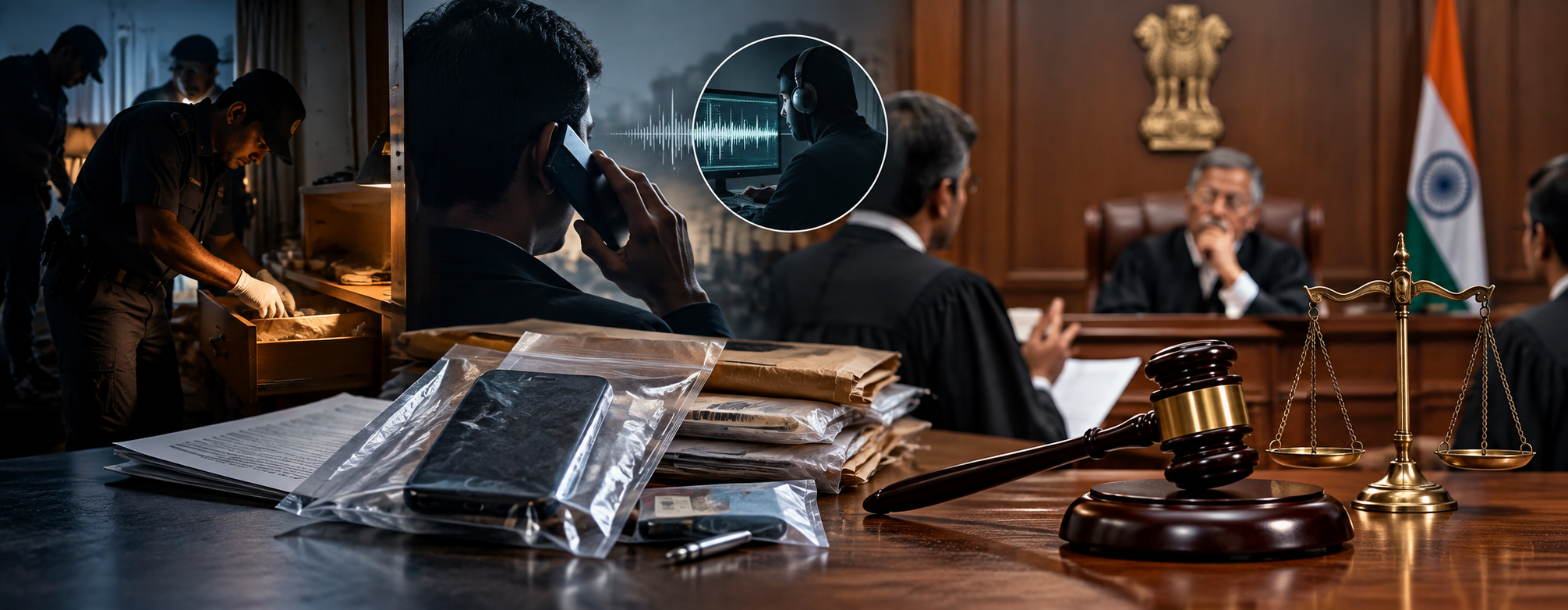
A common misconception in Indian criminal jurisprudence is that evidence collected through illegal means — an unauthorized search, an unlawfully intercepted call, or a seizure made without following due procedure — cannot be used in court. In reality, Indian law takes a markedly different approach from jurisdictions like the United States, which follow a strict “exclusionary rule” barring evidence tainted by illegal collection. Under the Indian Evidence Act, 1872, the test for admissibility is relevance to the facts in issue, not the propriety of how that evidence came to be in the prosecution’s hands.
This position was cemented by the Supreme Court in R.M. Malkani v. State of Maharashtra (1973), where a tape-recorded conversation obtained without the speaker’s knowledge was held admissible, the Court reasoning that the method of collection does not taint otherwise genuine and relevant material. The principle was reinforced in Pooran Mal v. Director of Inspection (1974), where documents seized during a search later found to be illegal were still allowed as evidence, since the Evidence Act contains no provision excluding material merely because it was unlawfully procured.
The underlying rationale is straightforward: the guilt or innocence of an accused should be determined on the merits of the evidence itself, not on procedural lapses by the police or investigating authorities. That said, this is not an unlimited license. Courts retain discretion to exclude evidence where its prejudicial value outweighs its probative worth, or where its admission would violate a constitutional safeguard — most notably Article 20(3), which protects against self-incrimination. Illegality in collection may also expose the errant official to separate departmental or criminal liability, even as the evidence itself survives in court.